
Postgres Woman of the Month October 2025 - Ellyne Phneah
Introduction:
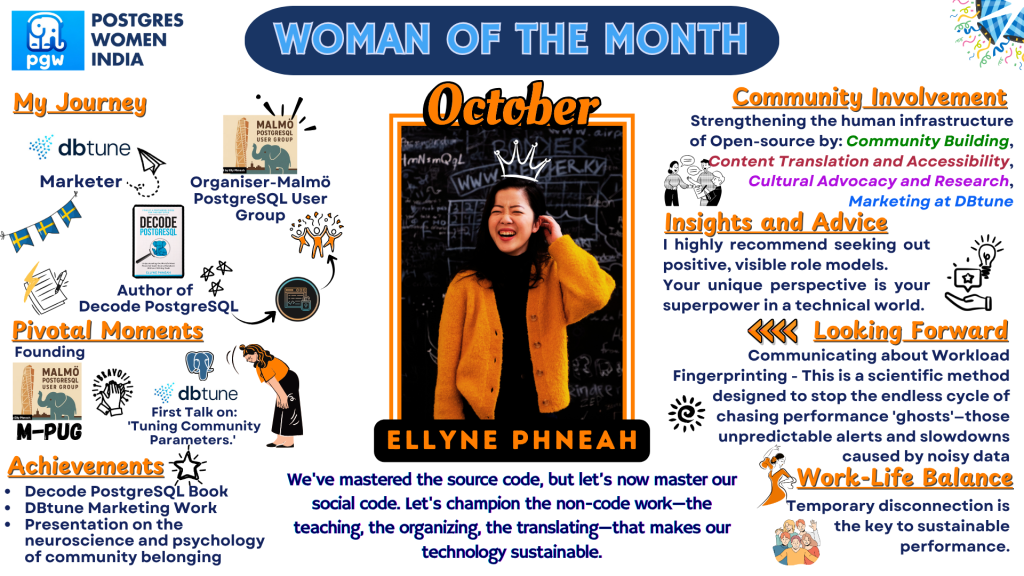
Hello, I’m Elly and I work at Marketing in DBtune, an AI-powered optimizer for PostgreSQL database configurations. I spent over a decade working in journalism, communications and marketing, covering topics from cybersecurity to cloud computing. This focus is also why I authored the book, Decode PostgreSQL, which aims to make the technology accessible to non-technical professionals.
Within the PostgreSQL community, I focus on the ‘people’ part of the equation. I’m one of the organizer for the Malmö PostgreSQL User Group (M-PUG) in the Nordics, where our goal is to create inclusive, high-energy spaces for learning and connection.
Journey in PostgreSQL
My journey into the PostgreSQL world was a little unconventional, I wasn’t a DBA or a developer, but a communicator. After working in Singapore for 10 years, I moved to Sweden to complete my Master’s degree, and got my first full-time position at DBtune. My role required me to quickly get up to speed on learning about Machine Learning and PostgreSQL. Through this period of learning, I had a revelation: I realized this technology was powered by a thriving open-source community, an entire ecosystem. I realized there was a huge, underserved audience of smart non-technical people who needed to understand this technology without having to learn SQL. That gap inspired my work, including writing the book Decode PostgreSQL, to function as the in-between between the genius engineers and the rest of the business world. My involvement evolved from appreciating the tech to actively working to make it accessible to the world.
Can you share a pivotal moment or project in your PostgreSQL career that has been particularly meaningful to you?
The first was founding the Malmö PostgreSQL User Group, M-PUG with Luigi Nardi, Daniel Gustafsson and Dennis Rilorin. We noticed a concentration of brilliant database talent but no dedicated local meetup. Starting M-PUG from scratch and seeing it grow into a vibrant space as we bring in international speakers every 6-8 weeks has been incredibly meaningful. It reinforced my belief that community is the essential ‘performance tuning’ for open-source.
The second moment was giving my first talk at a major PostgreSQL conference on the subject of ‘Tuning Community Parameters.’ It was a massive step to move from communicating about tech to sharing strategy with the tech community itself. Receiving positive feedback confirmed that my unique background, focused on strategy, narrative, and human systems, was genuinely valuable to a community traditionally defined by code. On that note, I must sincerely thank DBtune for their support and commitment to sponsoring my time and travel to attend events like this is a fantastic example of a company investing directly in the human infrastructure of the PostgreSQL ecosystem.
Contributions and Achievements:
There is the Decode PostgreSQL book. I’m incredibly proud that it provides a jargon-free bridge for business leaders and product people, allowing a whole new audience to understand and advocate for this powerful technology without having to write a single line of code. This led to my talk ‘Explaining PostgreSQL like I’m Five (or 85),’, which underscores the belief that the quality of our code is inseparable from the quality of our communication.
DBtune’s work in marketing for DBtune has been a significant contribution to the broader ecosystem. Our efforts focus on explaining why AI-powered tuning is essential to the sustainability of the PostgreSQL database. Traditional parameter tuning is highly manual, complex, and prone to human error, a major drain on DBA time. By highlighting how DBtune’s machine learning autonomously optimizes performance, we champion a critical conversation about making Postgres operations more efficient and accessible.
Third is the work I presented on the neuroscience and psychology of community belonging. After running a community belonging survey, I realized the biggest barrier to participation isn’t technical skill; it’s the fear of looking stupid or being excluded. My talks, like ‘Postgres and People: The Neuroscience of Why We Stick Around,’ gave the community data-backed tools to consciously build a safer, more ‘sticky’ environment.
(II) Have you faced any challenges in your work with PostgreSQL, and how did you overcome them?
The process of writing Decode PostgreSQL was a profound masterclass in overcoming imposter syndrome and prioritizing discipline over motivation, over fleeting inspiration; it was often a lonely, relentless act of will.
This resilience, which taught me the power of showing up even when I felt inadequate, prepared me for the emotional weight of the other major challenge: the raw, sometimes painful, feedback from the community belonging survey. Seeing that newcomers felt intimidated or excluded was heartbreaking, as it pointed to a gap in our ‘social code.’ I channeled that emotional energy into a positive, actionable response, transforming the data into the ‘Micro-Inclusion Toolkit’ to consciously improve the welcoming environment of the community.
Community Involvement:
My engagement revolves around my core mission of strengthening the human infrastructure of open source, which breaks down into four main pillars:
Community Building: I, along with other organizers, create regular, welcoming spaces for enthusiasts in the Nordics to connect, learn, and collaborate at Malmo PostgreSQL user group.
Content Translation and Accessibility: This includes authoring the book, Decode PostgreSQL, to make the technology understandable to business and non-technical professionals.
Cultural Advocacy and Research: My work on the neuroscience and psychology of community belonging led to my talks on strengthening our ‘social code’ for better retention.
Marketing at DBtune: Together with my team, we champion conversations about the sustainability and future of PostgreSQL operations, particularly how AI-powered tuning can help DBAs and developers work more efficiently.
(II) Can you share your experience with mentoring or supporting other women in the PostgreSQL ecosystem?
My approach is less about formal mentorship and more about active advocacy, creating structures for inclusion, and leading by example.
My visibility as a non-technical professional, minority race and gender in Europe (and even being the shortest person in the room and on stage!) speaking at major conferences is a form of support in itself. By showing up authentically as myself, sharing my unique strategic insights, I demonstrate that the community needs and values diverse skill sets beyond writing code.
The work I do on community culture directly addresses the barriers women and other underrepresented groups face. The Micro-Inclusion Toolkit, built from my survey data, gives everyone, regardless of gender, practical tools to reduce social pain and foster psychological safety, the fundamental requirement for anyone to contribute.
Insights and Advice:
I highly recommend seeking out positive, visible role models. Seeing women bring a creative edge to non-technical roles shifted my perception of what’s possible. For me, connecting with incredible leaders like Cornelia Biasics of CYBERTEC, Valeria Kaplan of Data Egret, Gulcin Yildirim Jelinek of Xata, Stacey Haysler of PGX, Priyanka Chatterjee of Schwarz, Floor Drees of EDB, provided that essential sense of validation and inspiration.
You should also actively join your communities. Don’t just be a passive member. Get involved with groups like the Postgres Women India, Telegram channels, participate in diversity committees. These spaces are invaluable for finding support, collaboration, and psychological safety.
Finally, embrace your creative side. I’ve always been a little bit of a rebel, which means, I’m not always conventional. I moved halfway across the world in the middle of my career and came into this highly technical community saying, ‘I’m going to write a book about the database without writing any code.’ In a professional sense, this means having the confidence to challenge the status quo, bringing your non-traditional skills to the table, and realizing that your unique perspective is your superpower in a technical world.
(II) Are there any resources (books, courses, forums) you’d recommend to someone looking to deepen their PostgreSQL knowledge?
Decode PostgreSQL (My Book): I have to start here! If you are a product manager, marketer, executive, or even a new developer trying to understand the “why” of the database without diving into code, this book is built for you. It uses metaphors and simple language to bridge the knowledge gap.
Explaining PostgreSQL like I’m Five (or 85): This resource, from my talk at pgDay UK, is great for internal communication. It teaches you metaphors and frameworks for translating complex terms like “indexing” and “query plans” into language your whole team, from the CEO to the newest analyst, can understand.
PostgreSQL Administration Cookbook (By Simon Riggs, et al.): Once you understand the why from my book, this cookbook provides the hands-on reference for the how. It’s a foundational resource for understanding the practical tasks your DBAs or DevOps team execute daily in a production environment.
Generative AI for Web Development (By Emma Saroyan and Tom Auger): PostgreSQL is the data backbone for many new AI apps (often using extensions like pgvector). This shows web developers how to build AI-powered apps with Next.js and OpenAI, giving them the context to understand why they need a reliable database like Postgres.
Looking Forward:
I’m excited by anything that lowers the barrier to entry and increases operational sustainability. On the core technology side, the developments coming in PostgreSQL 18 are pushing the boundaries of what the database can achieve. There’s exciting work around enhanced parallelism, more efficient vacuum processes, and better native support for emerging data types and SQL standards.
Another development is at DBtune where we are deeply focused on developing Workload Fingerprinting. This is a scientific method designed to stop the endless cycle of chasing performance ‘ghosts’—those unpredictable alerts and slowdowns caused by noisy data. This helps them to prioritize efforts and transform performance tuning from a subjective art into a precise science. It will not only make databases more efficient, but also the lives of the people running it significantly easier and effective. As I outlined during my lightning talk at PGDay Napoli, . it’s time for us to become ‘Ghostbusters’ in the database world, going after the underlying slime in the workload.
(II) Do you have any upcoming projects or goals within the PostgreSQL community that you can share?
The first is centered on content accessibility. I’ll start working on Version 2 of Decode PostgreSQL, incorporating the newest features and insights from the community. I want to get the book listed on platforms like Amazon and ramp up the promotion to reach a far wider audience of professionals who need that foundational knowledge. More ambitiously, I plan to turn Decode into a series that translates other complex technical fields, such as Machine Learning and Cybersecurity.
I also want to deepen cultural advocacy. I want to expand on my initial community belonging research, move from a survey-based assessment to a more in-depth cultural analysis. The goal is to move beyond simply identifying the challenges of inclusion and start creating more refined, scalable frameworks to improve the ‘social code’ of open source. It’s about ensuring the human infrastructure of PostgreSQL is as resilient, high-performing, and welcoming as the database itself.
Personal Reflection:
Being part of the PostgreSQL community is about so much more than the code or the technology—it’s about belonging to a global, decentralized ecosystem that is fundamentally human.
The community represents a powerful collective intelligence where diverse skill sets are not just tolerated, but celebrated. It’s where I was able to transform my background as a journalist and a strategist into a unique contribution: bridging the gap between deep technical innovation and the people who need to use it.
I also get to be part of a movement dedicated to sustainable, collaborative growth. It’s where I found my mission: building the ‘social code’ that ensures we don’t just innovate technically, but also create the safety and culture required for the next generation of contributors, regardless of their background, to thrive.
(II) How do you balance your professional and personal life, especially in a field that is constantly evolving?
I try to actively protect my time. While I’m fully committed to my work, I’ve learned that temporary disconnection is the key to sustainable performance. I am an avid Latin dancer and I also do calisthenics. Most of my classes are after office hours and I tell myself to temporarily disconnect during those blocks. These activities are like meditation for me; they reset my mind, and when I get back, I come back sharper, more focused, and more creative. As Brené Brown says, ‘Daring to set boundaries is about having the courage to love ourselves, even when we risk disappointing others.’ That quote has been key to me in maintaining my long-term sustainability.
I also place a huge emphasis on prioritizing friends and family. As an Asian, there is an ingrained sense of duty and community in our culture. Success isn’t just professional; it’s communal. Making time to nurture those relationships is non-negotiable. It’s what keeps me grounded and provides the emotional resilience needed to tackle the highly dynamic tech world.
Message to the Community:
To the entire PostgreSQL community: We’ve mastered the source code, but let’s now master our social code. We must actively ensure that our community is inclusive and safe enough for every talented person to contribute. Let’s champion the non-code work—the teaching, the organizing, the translating—that makes our technology sustainable.
And to the women who are here or who aspire to join: Your unique skill set is your superpower. Whether you’re a developer, a student, or in business functions, we need your perspective. Don’t feel pressured to conform to one mold. And crucially, remember to embrace your inner rebel. This difference is a strength. Women often excel in areas like systems thinking, collaborative problem-solving, and empathetic communication, which are crucial for high-functioning teams and open-source communities. We are stronger because you are here, ready to challenge the status quo and help us grow


 Anuradha Chinta
 Haimantika Mitra
 Gayathri Varadarajan
  Chandini Kurada
  Vanya Seth
 Madhavi Datla

 Rumi
Rumi  Bhavani Indukuri