
Introduction:
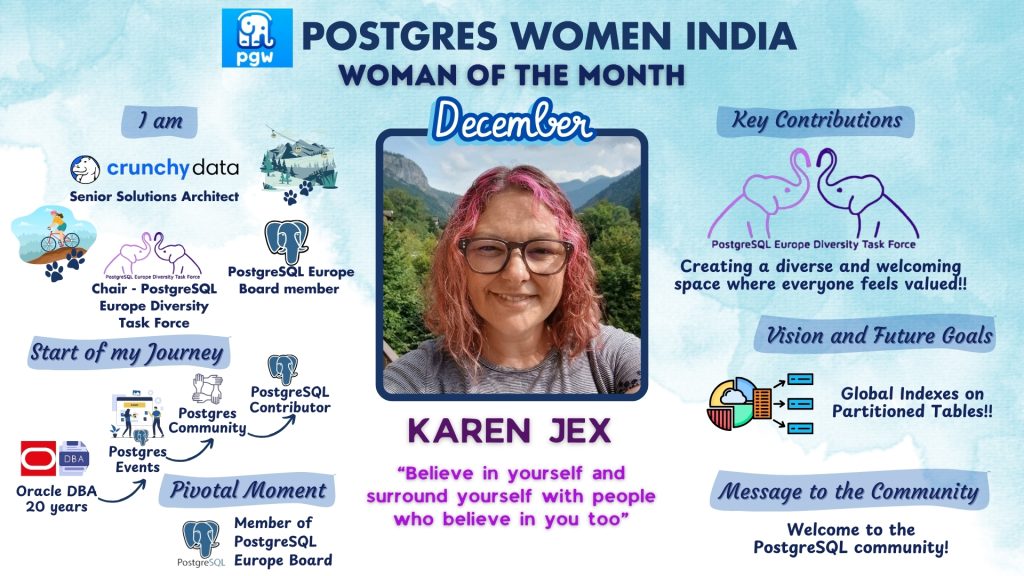
My day job is Senior Solutions Architect at Crunchy Data, which I came to via a long history as a database administrator (DBA). I’m a PostgreSQL Europe Board member and I chair the PostgreSQL Europe Diversity Task Force. I’ve just been recognised as a PostgreSQL Contributor, which I’m really proud of. I live in a little village in the French Alps with my family and our 2 rescue dogs where I love cycling and mountain biking.
Journey in PostgreSQL:
Completely by accident! I had been an Oracle DBA for 20 years when the company I was working for decided to use PostgreSQL for their next project. Since I was the “database expert”, it was my job to learn how to use Postgres and then teach the rest of the team about it. I went to some Postgres events to help me to get up to speed, and quickly became involved with the Postgres community.
Can you share a pivotal moment or project in your PostgreSQL career that has been particularly meaningful to you?
Being nominated for and elected to the PostgreSQL Europe Board earlier this year was a really proud moment for me. It’s a huge privilege to be able to work on behalf of the community in that way.
Contributions and Achievements:
The contribution that I’m most proud of is forming the PostgreSQL Europe Diversity Task Force. I’m working with a committee of fantastic volunteers who are all really enthusiastic about making sure the PostgreSQL Europe community is a diverse and welcoming space where everyone feels valued.
Have you faced any challenges in your work with PostgreSQL, and how did you overcome them?
Whether it’s a tricky technical problem or any other challenge that comes up, I can always talk it through and get help from one of my friends in the PostgreSQL community. That sounds really sickly sweet, but it’s true!
Community Involvement:
As well as the ways I’ve already mentioned, I love being involved with PostgreSQL conferences. I’m on the PGConf.EU organisation team, I’ve chaired the talk selection committee for several events, and I volunteer to help out at events whenever I can. It’s very rewarding and it’s a great way to get to know people and feel involved with the community. I also love to give talks at PostgreSQL and developer events to spread the love for PostgreSQL and for databases in general!
Can you share your experience with mentoring or supporting other women in the PostgreSQL ecosystem?
Although I haven’t been involved in any official mentoring schemes (yet!) I’ve received a lot of help from, and try to give support to, other women in the PostgreSQL community. Lætitia Avrot is the first “Postgres Person” that I met when I started my Postgres journey, and she went out of her way to make sure I felt welcomed and included. It made a huge difference to me, and we went on to become colleagues and good friends. My goal, whenever I meet a new member of the community, is to be as welcoming and helpful as Lætitia was to me.
Insights and Advice:
Believe in yourself, and surround yourself with people who believe in you too.
Are there any resources (books, courses, forums) you’d recommend to someone looking to deepen their PostgreSQL knowledge?
I always find this question hard to answer, because there are so many PostgreSQL resources out there, and it depends what level you’re at, what kind of learning resources you like best etc.
If you like reading blog posts, Planet PostgreSQL could be a good place to start – it aggregates blogs from lots of different people in the PostgreSQL community, so you might find one or more that you want to follow.
There’s no substitute for in-person events for watching talks and connecting with people, but a lot of the PostgreSQL conferences also make talks available after the event. Talks from some of the conferences under the PostgreSQL Europe umbrella can be found here, for example.
Looking Forward:
Partitioning has become more and more useful and robust over the previous releases. The next big step for me, and the one that would make me much more confident recommending partitioning to customers as a strategy for managing large tables, would be global indexes on partitioned tables.
Do you have any upcoming projects or goals within the PostgreSQL community that you can share?
The PostgreSQL Europe Diversity Task Force is going to take up a lot of my time and energy for the foreseeable future. The committee will be meeting in person during PGConf.EU so we can make solid plans – hopefully we’ll have exciting news to share very soon after that!
Personal Reflection:
Sharing experiences with and supporting my PostgreSQL colleagues, and working together to make sure the whole PostgreSQL project continues to be successful.
How do you balance your professional and personal life, especially in a field that is constantly evolving?
PostgreSQL is my career and my hobby, and it’s where a lot of my friends are so it does tend to take up a lot of my time! Fortunately, I have a lovely family that reminds me to switch off the computer and spend time with them doing the things that we enjoy like getting out on our bikes and taking walks in the mountains.
Message to the Community:
Welcome to the PostgreSQL community! If there’s anything you’re not sure about or need help with, don’t hesitate to reach out and ask a question or even just say “hi”.


 Anuradha Chinta
 Haimantika Mitra
 Gayathri Varadarajan
  Chandini Kurada
  Vanya Seth
 Madhavi Datla

 Rumi
Rumi  Bhavani Indukuri