
Shruti Rawal - Rookie of the Month August 2026
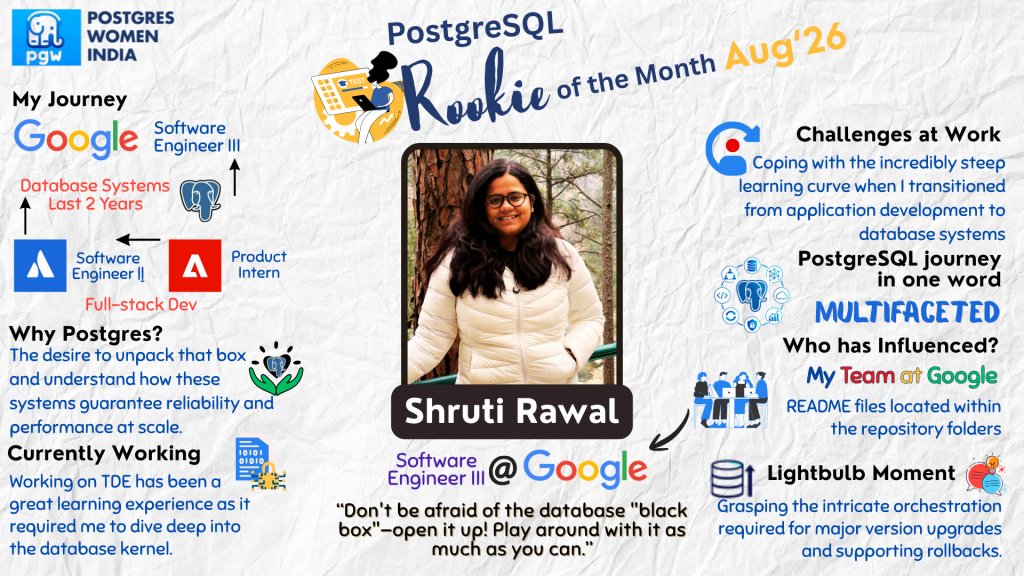
1) Let’s start with you!
Tell us a bit about yourself – your background, current role, and what excites you most in the world of tech.
I started my career with a focus on full-stack application development, working with Spring Boot and ReactJS during my time at Adobe and Atlassian. However, since joining Google, my focus has shifted entirely to database systems. Currently, I am a Software Engineer on the AlloyDB Omni team, where I work on core database kernel features and the Kubernetes control-plane. In the tech world, I am most excited by the sheer complexity and scale of the problems we get to solve. It’s thrilling to navigate across diverse domains and engineer them to work together seamlessly.
2) Why PostgreSQL? What inspired you to explore or switch to PostgreSQL?
As an application developer, databases were always a crucial but somewhat mysterious “black box” in the stack. What inspired me to switch to database development was the desire to unpack that box and understand how these systems guarantee reliability and performance at scale. PostgreSQL, with its rich history, open-source nature, and massive community, felt like the perfect place to start that exploration. The opportunity to move from just using databases to actually contributing to their evolution was something I couldn’t pass up..
3) What are you working on with PostgreSQL right now?
Share the cool stuff you’re building, learning, or solving using PostgreSQL.
As a Software Engineer on the AlloyDB Omni team, my work spans across the Kubernetes control plane for Omni and the core AlloyDB kernel to develop key features. Recently, my focus has been on major version upgrades and implementing Transparent Data Encryption (TDE) to transparently encrypt data at rest. Working on TDE has been a great learning experience as it required me to dive deep into the database kernel, understanding block layouts, buffer management, and how encryption interacts with the I/O subsystem..
4) What’s been your biggest learning or challenge on this journey?
A lesson, mistake, or an aha moment, we’d love to hear about it!
The biggest challenge was coping with the incredibly steep learning curve when I transitioned from application development to database systems. Absolutely everything—from the tech stack to the domain concepts—was new. My biggest engineering challenge was implementing TDE in a way that minimizes performance impact. Through this, I learned that keeping scale and reliability in mind at every step is crucial for making data-driven design decisions.
5) Your wisdom to rookies like yourself?
Don’t be afraid of the database “black box”—open it up! Play around with it as much as you can. Reading deep-dive articles (like on Medium) is great for conceptual understanding, but if you want to understand the core internals, there is nothing as effective as the old-fashioned way: reading the source code piece by piece. Also, don’t hesitate to leverage modern AI tools to accelerate your research when diving into complex topics.
6) Finally, describe your PostgreSQL journey in one word.
Yep, just one!
Multifaceted
7) Who or what has influenced your PostgreSQL learning the most?
A mentor, a community, a course, a project, tell us what or who helped you grow.
My team at Google has been an incredible support system, helping me navigate the steep learning curve from day one. Beyond that, my learning has been heavily self-driven by reading the Postgres codebase directly. In particular, the README files located within the repository folders were very helpful. I’ve also relied on technical blogs, Medium articles, and AI tools to help deconstruct complex concepts.
8) What’s one PostgreSQL concept or feature you finally understood and felt proud of?
That lightbulb moment when something clicked, we all have one!
My biggest lightbulb moment was finally grasping the intricate orchestration required for major version upgrades and supporting rollbacks. Understanding how catalog metadata changes, physical storage compatibility, and control-plane orchestration must align perfectly to ensure data integrity during upgrades was both challenging and incredibly rewarding to master.


 Anuradha Chinta
 Haimantika Mitra
 Gayathri Varadarajan
  Chandini Kurada
  Vanya Seth
 Madhavi Datla

 Rumi
Rumi  Bhavani Indukuri