
Postgres Woman of the Month September 2026 - Anuradha Chintha

Introduction:
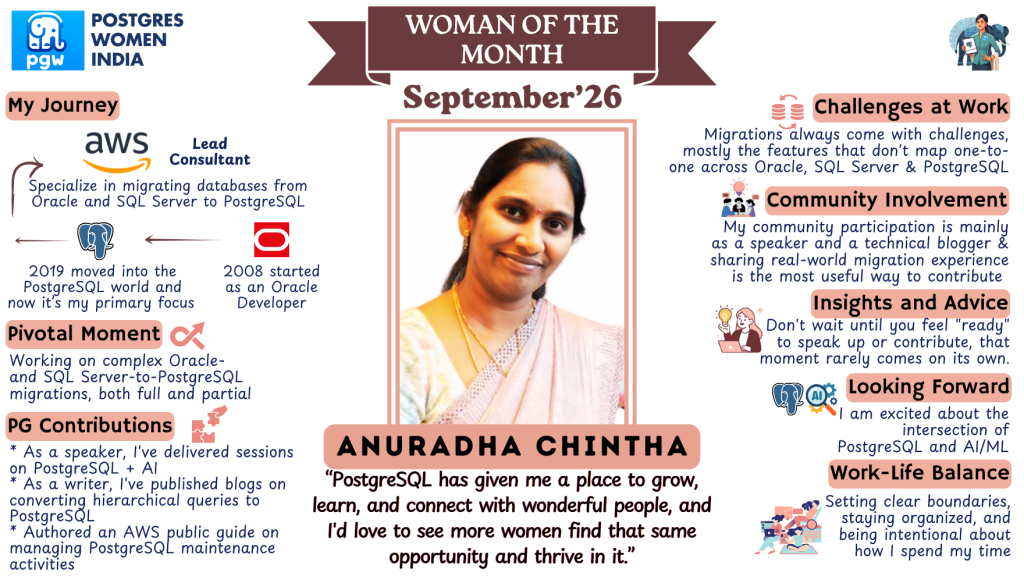
I started my career in January 2008 as an Oracle Developer, where I built my foundation in database design, development, and performance tuning. In 2019, I moved into the PostgreSQL world and it’s been my primary focus ever since. Today I specialize in migrating databases from Oracle and SQL Server to PostgreSQL, having worked on several end-to-end and partial migration projects covering schema conversion, data migration, and application changes. My work also extends beyond the database itself, I have hands-on experience with DevOps tools and running workloads on Amazon EKS, which helps me approach migrations from an end-to-end delivery perspective. Within the community, I’m active as a speaker and technical blogger, sharing what I learn along the way and helping others on their own migration journeys.
Journey in PostgreSQL`
My journey began in 2019. After more than a decade working with Oracle, I started taking on database migration projects where the target was PostgreSQL. What began as learning a new database for a specific project quickly turned into genuine enthusiasm. The more I worked with PostgreSQL, its open-source nature, rich feature set, and the strength of its community, the more I wanted to go deeper. It didn’t take long for it to become the center of my work.
Can you share a pivotal moment or project in your PostgreSQL career that has been particularly meaningful to you?
One of the most meaningful experiences has been working on complex Oracle- and SQL Server-to-PostgreSQL migrations, both full and partial. For the partial migrations, doing dependency-level analysis at the source was key: understanding how objects relate to one another let me carve out and move the right pieces safely without breaking the rest of the system. On the SQL Server side, I ran into some genuinely tricky problems, migrating case-insensitive collation databases, handling cross-database and linked server procedure calls, and working around culture/locale-specific behavior in PostgreSQL. Solving these, along with Oracle-specific conversions like hierarchical (CONNECT BY) queries, collections, and UTL_FILE operations, and then turning them into blogs and sessions for others, has been one of the highlights of my career.
Contributions and Achievements:
I‘ve contributed mainly through knowledge sharing. As a speaker, I’ve delivered sessions on PostgreSQL transactions, the pgml extension, and building AI agents using PostgreSQL. As a writer, I’ve published blogs on converting hierarchical queries to PostgreSQL, handling external tables and UTL_FILE operations, and migrating Oracle collections. I also authored an AWS public guide on managing PostgreSQL maintenance activities. Beyond the database layer, my experience with DevOps tooling and Amazon EKS has helped me contribute a more holistic, deployment-aware view of migrations. I’m proud that these resources help practitioners tackle real migration problems end to end.
(II) Have you faced any challenges in your work with PostgreSQL, and how did you overcome them?
Migrations always come with challenges, especially around features that don’t map one-to-one across Oracle, SQL Server, and PostgreSQL. On the Oracle side, that meant hierarchical queries, collections, and file handling. On the SQL Server side, some of the toughest problems were migrating case-insensitive collation databases, handling cross-database and linked server procedure calls, and working around culture/locale-specific differences. Partial migrations added another layer, since I had to perform detailed dependency-level analysis at the source to decide exactly what could be moved without disrupting the rest of the system. I overcame these by digging into PostgreSQL’s documentation, experimenting with different approaches (like using appropriate collations, extensions, and refactoring cross-database calls to fit PostgreSQL’s model), leaning on the community, and testing thoroughly. My DevOps and EKS background helped with the infrastructure and deployment side. Once I found reliable patterns, I documented them so the next person, and my future self, wouldn’t have to start from scratch.
Community Involvement:
I engage with the community mainly as a speaker and a technical blogger. I’ve delivered sessions on topics like PostgreSQL transactions, the pgml extension, and building AI agents using PostgreSQL, and I regularly participate in community events such as PGDay and PGHyd. Writing blogs on practical migration topics, hierarchical query conversion, collection migration, external tables and UTL_FILE handling, is another big part of how I stay connected and give back. For me, sharing real-world migration experience is the most useful way to contribute, because it helps others who are working through the same problems.
(II) Can you share your experience with mentoring or supporting other women in the PostgreSQL ecosystem?
I try to support others by sharing knowledge openly and making complex topics approachable, whether that’s through my blogs, my sessions, or one-on-one conversations. I’ve found that a lot of people, women especially, hesitate to contribute because they feel they need to be experts first. I like to encourage them to start where they are, ask questions, and share what they know. Being visible as a woman working on challenging database migrations and speaking at community events is itself a way of showing others that there’s a place for them here too.
Insights and Advice:
Build a strong foundation in database fundamentals, those concepts carry across every platform and will serve you no matter how technology shifts. Be curious and don’t shy away from the hard problems, because that’s usually where the most growth happens. With PostgreSQL specifically, take full advantage of its open-source nature: read the documentation, experiment freely, and lean on the community. And when you learn something, share it. Teaching others is one of the fastest ways to deepen your own understanding and build confidence. Most importantly, don’t wait until you feel “ready” to speak up or contribute, that moment rarely comes on its own.
(II) Are there any resources (books, courses, forums) you’d recommend to someone looking to deepen their PostgreSQL knowledge?
The official PostgreSQL documentation is genuinely one of the best resources available and worth reading closely, it’s thorough and well maintained. Beyond that, the PostgreSQL mailing lists and community events like PGDay PWI events and PGHyd are excellent for learning directly from experienced practitioners. I’d also recommend following community and vendor blogs (including AWS guides) for real-world migration and operational patterns. But nothing replaces hands-on practice, setting up your own PostgreSQL environment and experimenting is the fastest way to learn.
Looking Forward:
I’m especially excited about the intersection of PostgreSQL and AI/ML. Extensions like pgml and the growing use of PostgreSQL for building AI agents open up a lot of possibilities, and it’s exciting to see a mature, reliable database evolve into a platform for modern AI workloads. I’m also keen on the continued improvements that make migrations from Oracle and SQL Server smoother, since that’s so close to my day-to-day work.
.
(II) Do you have any upcoming projects or goals within the PostgreSQL community that you can share?
I want to keep sharing knowledge through more sessions and blogs, particularly around migration best practices, the tricky SQL Server and Oracle conversion challenges, and the AI/ML side of PostgreSQL. My broader goal is to make complex migrations feel less intimidating and to encourage more people, especially women, to get involved and contribute to the community.
Personal Reflection:
It means being part of something open, collaborative, and generous. The PostgreSQL community shares knowledge freely and genuinely welcomes newcomers, and being able to both learn from it and give back has been one of the most fulfilling parts of my career. It’s a community that rewards curiosity and participation, which keeps me motivated to keep growing.
(II) How do you balance your professional and personal life, especially in a field that is constantly evolving?
I focus on steady, continuous learning rather than trying to absorb everything at once, that keeps me current without burning out. I also treat my community work, writing and speaking, as something I genuinely enjoy rather than an extra obligation, so it energizes me instead of draining me. Setting clear boundaries, staying organized, and being intentional about how I spend my time help me keep work and personal life in balance.
Message to the community
To the women in and around this community: your perspective and your skills matter, and there is absolutely room for you here. Don’t wait until you feel like an expert to contribute, start where you are, ask questions, share what you learn, and support one another. PostgreSQL has given me a place to grow, learn, and connect with wonderful people, and I’d love to see more women find that same opportunity and thrive in it.


 Anuradha Chinta
 Haimantika Mitra
 Gayathri Varadarajan
  Chandini Kurada
  Vanya Seth
 Madhavi Datla

 Rumi
Rumi  Bhavani Indukuri