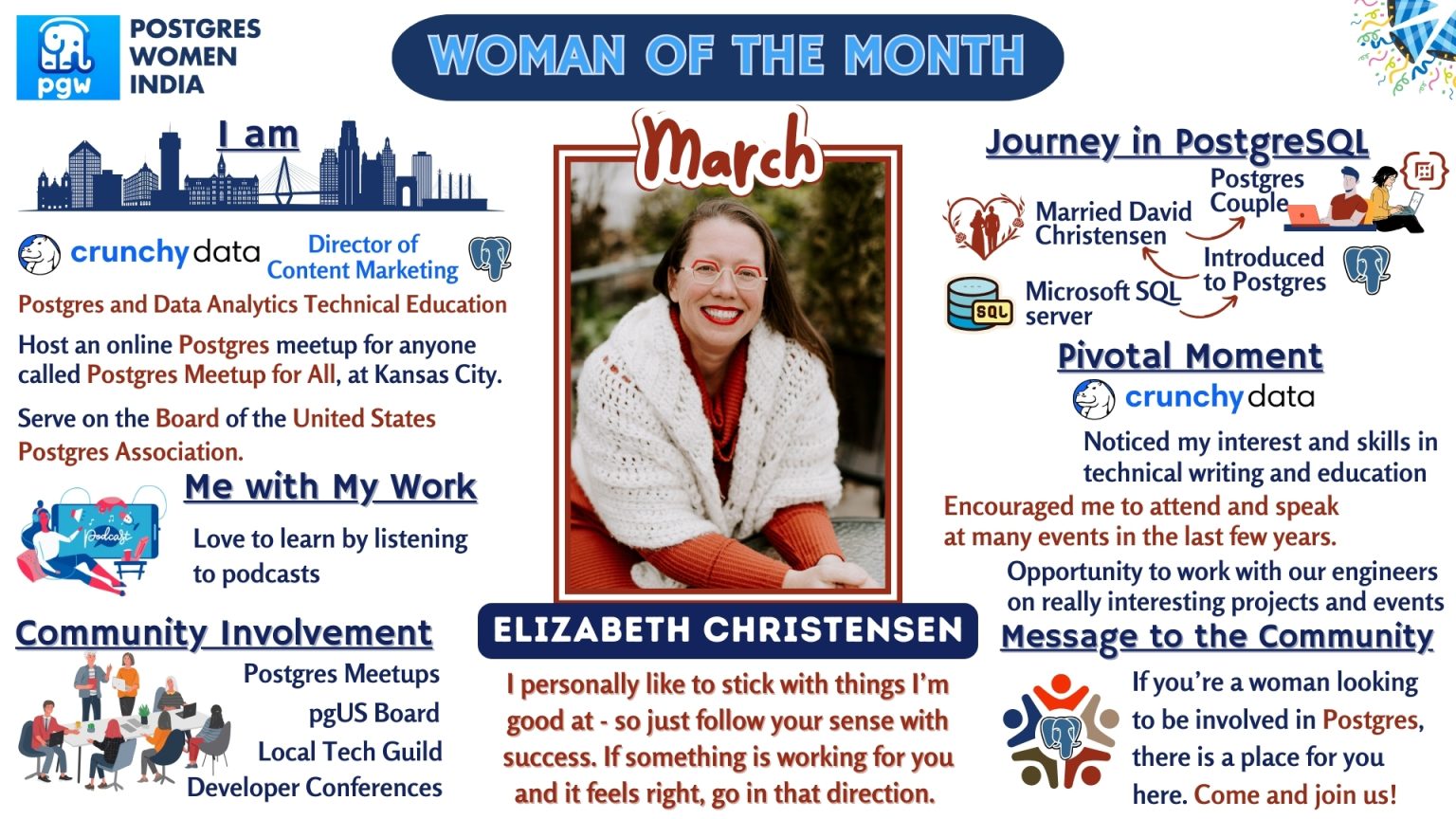
Introduction:
Thank you for the invitation to participate! I have a background in open source software and technical writing / publishing. I currently work at Crunchy Data as the Director of Content Marketing where my focus is on Postgres and data analytics technical education. I have a Postgres meetup locally where I live in Kansas City and host an online Postgres meetup for anyone called Postgres Meetup for All. I also serve on the Board of the United States Postgres Association – that focuses on events, education, and professional development for those working in PostgreSQL.
Journey in PostgreSQL
The first database I worked with was Microsoft SQL server so I knew about SQL a bit before I heard about Postgres. I first heard about Postgres when my team was transitioning from IIS to Apache and we were checking out open source database options that would run on Linux. Soon after I married a Postgres person, David Christensen. David has been involved with Postgres for the last 15 years and over the last 10 years we’ve worked together. My skills and interest in the project have evolved quite a bit. David and I are the only married couple where both people have code patches in the project (though there are several other couples working in Postgres together).
Can you share a pivotal moment or project in your PostgreSQL career that has been particularly meaningful to you?
Working for Crunchy Data has been a pivotal moment for me, especially working with Craig Kerstiens. I started out helping Craig with all kinds of things at Crunchy Data and he saw my interest and skills in technical writing and education and encouraged me to spend more time pursuing those interests. Since I’ve been with Crunch Data I’ve learned so much about Postgres, being able to work with our engineers on really interesting projects and events. Crunchy Data has encouraged me to attend and speak at many events in the last few years too.
Contributions and Achievements:
I haven’t faced too many challenges with Postgres to be honest. In fact, I’ve found the Postgres community to be incredibly supportive and interested in my participation and contributions. Many of the Postgres leaders are seeking more involvement from women in the community and this has been a great time to be involved.
Have you faced any challenges in your work with PostgreSQL, and how did you overcome them?
I haven’t faced too many challenges with Postgres to be honest. In fact, I’ve found the Postgres community to be incredibly supportive and interested in my participation and contributions. Many of the Postgres leaders are seeking more involvement from women in the community and this has been a great time to be involved.
Community Involvement:
I host a couple meetups which is a really great opportunity to work with users and others in the Postgres community. In my work with the pgUS Board, I often exhibit at developer conferences like Djangocon or Pycon where I get a chance to talk with users about Postgres and help folks get involved in the project. I also really like engaging with the broader developer community to talk about Postgres and create more exposure for the project. I am active in my local tech guild and our local developer conference.
Can you share your experience with mentoring or supporting other women in the PostgreSQL ecosystem?
I have several female friends in Postgres and we’re all supporting each other – though it is a bit ad hoc. pgUS has a diversity program that helps women and minorities attend Postgres conferences and I’m always eager to support that initiative. I am so impressed with what Postgres Women India is doing – to support the women in Postgres in a formal way with a newsletter and other programming.
Insights and Advice:
For women just starting out, there’s so much out there for you. Pick a few things to really dig into, you can’t be good at everything. I personally like to stick with things I”m good at – so just follow your sense with success. If something is working for you and it feels right, go in that direction.
Are there any resources (books, courses, forums) you’d recommend to someone looking to deepen their PostgreSQL knowledge?
For Postgres resources, there’s so many good blogs out there so I really enjoy following the Planet Postgres (https://planet.postgresql.org/) blog aggregator. I also really enjoy reading the Cooper Press Postgres weekly publication and the pgMustard newsletter. The Postgres FM podcast is something I also like and I can do that while I’m away from my keyboard.
Looking Forward:
Two things are really exciting to me – 1) Analytical workloads: There is a lot happening now with Postgres and merging transactional workloads with analytical workloads. Crunchy Data has a new hybrid data warehouse and there’s a couple other projects that fuse DuckDB or other tools to make Postgres better for OLAP workloads. I think there’s a lot of potential for Postgres adoption to grow into new fields for data science and analytics with this. 2) AI: With the pgvector extension, you can store AI embeddings from any LLM in the database and also enhance LLM data with local data. Postgres is almost like a data exchange layer for anyone that wants to use LLMs in an application. I think that will dramatically increase Postgres adoption as more developers work with AI and LLMS.
Do you have any upcoming projects or goals within the PostgreSQL community that you can share?
I would love to speak more internationally and I had a lot of FOMO seeing the recent Postgres India conference so I’d love to go to that in the future. I think I’ve planted the seeds for quite a few initiatives like my meetups, other Postgres events, and some of my work with the pgUS board. I’m mostly excited to continue to put effort into these and see how everything grows.
Personal Reflection:
Being part of the bigger Postgres community for me is about helping people get started and connected to the right resources to knowledge. I believe that quality education is the key to creating a diverse software community. So I want to be part of helping people get started and learn more to become better at Postgres – no matter where they start.
How do you balance your professional and personal life, especially in a field that is constantly evolving?
I’m really lucky that a huge part of my job is about learning. Either learning about Postgres features I’ve not used before or things coming out in new versions. I get to spend a lot of time learning, doing research, and then creating educational content for users. I like to do some kind of learning every week while I get outside and that’s usually listening to podcasts. Don’t tell my boss but occasionally I’ll watch talks about Postgres from my pool.
Message to the Community:
If you’re a woman looking to be involved in Postgres, there is a place for you here. Come and join us! My DM’s are open and I’d love to e-meet more friends in India.
Talk Title: PostgresML: Revolutionizing Machine Learning with SQL
In today’s data-driven world, organizations often struggle with complex machine learning infrastructures and data movement challenges. This talk introduces PostgresML, a game-changing PostgreSQL extension that brings machine learning capabilities directly into your database. We’ll explore how PostgresML enables developers and data teams to perform sophisticated ML operations using familiar SQL commands, eliminating the need for separate ML systems. Through live demonstrations, we’ll showcase practical implementations of model training, real-time predictions, and GPU acceleration features. Whether you’re a database engineer, ML practitioner, or technical lead, you’ll learn how to leverage PostgresML to simplify your ML pipeline, enhance security, and accelerate deployment. Join us to discover how this innovative tool is bridging the gap between traditional database operations and modern machine learning workflows.
Talk Title: Developers are decision-makers now. DevRel gets you there faster
DevRel as a role has existed since the 1990s, yet it remains one of the least understood roles in tech. Whether due to changing definitions, role titles, or evolving industries, DevRel has transformed significantly over the past few years—yet it continues to shape the devtool landscape. Since 2023, we’ve seen explosive AI growth alongside a surge in tech companies and technical talent. But who reaches these developers? Developers distrust traditional marketing. Who builds the samples, docs, tutorials, and SDKs they rely on? DevRel has become more critical than ever, especially as developers increasingly become decision-makers. In this talk, we’ll explore what DevRel is, how it drives impact, and how you can build an effective DevRel program.
Talk Title: DPDPA(Digital Personal Data Protection Act) Unleashed – Why It Matters for Women in Data
India’s Digital Personal Data Protection Act (DPDPA) is reshaping how organisations collect, store and use personal data, with a phased, 18‑month rollout. This presentation explores what’s in policy and law, then dives into what it unlocks for careers in data, security and consulting—especially for women. As data architect ,designing database architectures, will try connect legal constructs (Data Principals, Fiduciaries, Consent Managers, the Board) to real-world data and database practices, and show how DPDPA can be a powerful career accelerator, not just a compliance requirement.
Talk Title: Where Technology Meets Customer Needs: Lessons from a Newbie Solutions Engineer
When I stepped into the world of open-source databases as a Solutions Engineer, I expected to feel overwhelmed, but I found a role that made surprising sense. In this talk, I’ll share my journey navigating PostgreSQL with the help of modern cloud platforms like Aiven and DigitalOcean, tuning tools like DBtune, and migration partners like Hexacluster. This isn’t a deep-dive into internals, it’s a practical, beginner-friendly session to reducing the friction of managing PostgreSQL in real-world environments. Along the way, I’ll highlight the often-overlooked role of a Solutions Engineer: the human bridge between customer needs and engineering solutions. If you’re a student, a DBA, a DevOps engineer or just Postgres-curious, you’ll walk away with not only tools to explore, but also a career path to consider.

Talk Title: Architecting Ethical and Responsible AI with PostgreSQL 18
Have you ever developed an Agentic AI application using an agentic framework such as langGraph and pgai extension and noticed you don’t get good results during testing or the results are biased towards a demographic. You don’t know what to do. Organizations developing Agentic AI applications using an agentic framework such as LangGraph and pgai extension often encounter issues during implementation and testing, including suboptimal performance or bias in results such as demographic bias. Identifying the root causes of these issues can be difficult without proper tools and methodologies. This session addresses these challenges by introducing Responsible AI interpretability and explainability techniques. Participants will learn how to understand and trace the model’s decision-making process, enabling them to identify why specific results are generated. These capabilities are essential for meeting compliance requirements in regulated sectors, including banking and insurance. Attendees will gain practical knowledge on building Agentic AI applications that incorporate Responsible AI principles, ensuring transparent, accountable, and fair outcomes.
Rumi ![]()
Talk Title: New features of PostgreSQL 18
PostgreSQL 18 continues the PostgreSQL project’s long-standing focus on performance, scalability, reliability, and developer productivity, building incrementally on the improvements delivered in PostgreSQL 15–17.
Rather than introducing disruptive changes, PostgreSQL 18 is expected to emphasize refinement and maturity across core subsystems such as query execution, indexing, concurrency, replication, and observability, making PostgreSQL even more suitable for enterprise-scale and cloud-native workloads.
Talk Title: Platform Engineering Unpacked: Architecture, Evolution, and Hard-Won Lessons
The way engineering teams build and deliver software has changed dramatically. We’ve moved from manual server setups to automated pipelines, from ticket-based operations to self-service workflows, and from siloed teams to platform-driven organisations. This shift gave rise to Platform Engineering, a discipline focused on creating the internal systems, golden paths, and tooling that empower developers to move faster with less friction.
In this session, I’ll walk through the evolution that brought us here and why Platform Engineering has become a strategic priority across industries. I’ll share the architecture patterns that define successful platforms, how self-service emerges as a core capability, and the practical dos and don’ts learned from building real-world internal platforms.
Attendees will gain a clear understanding of:
Why DevOps wasn’t enough, and what Platform Engineering solves
The natural evolution from scripts → automation → abstractions → platforms
What makes a good platform (and what absolutely doesn’t)
How to design developer-centered systems and golden paths
My firsthand lessons from enabling engineering teams at scale
This talk gives a foundational, experience-driven view of what Platform Engineering really means today and how teams can start their journey the right way.
Our idea explores the implementation of AI-driven query optimization in PostgreSQL, addressing the limitations of traditional optimization methods in handling modern database complexities. We present an innovative approach using reinforcement learning for automated index selection and query plan optimization. Our system leverages PostgreSQL’s pg_stat_statements for collecting query metrics and employs HypoPG for index simulation, while a neural network model learns optimal indexing strategies from historical query patterns. Through comprehensive testing on various workload scenarios, we will validate the model’s ability to adapt to dynamic query patterns and complex analytical workloads. The research also examines the scalability challenges and practical considerations of implementing AI optimization in production environments.
Our findings establish a foundation for future developments in self-tuning databases while offering immediate practical benefits for PostgreSQL deployments. This work contributes to the broader evolution of database management systems, highlighting the potential of AI in creating more efficient and adaptive query optimization solutions.
This talk provides an introductory overview of Artificial Intelligence (AI) and Machine Learning (ML), exploring key concepts and their application in building intelligent systems. It will highlight the essential AI/ML techniques, such as supervised and unsupervised learning, and discuss practical use cases in modern industries. The session also focuses on how PostgreSQL, with its powerful extensions like PostgresML, TimescaleDB, and PostGIS, supports the development of AI-powered applications. By leveraging PostgreSQL’s ability to handle complex datasets and integrate machine learning models, participants will learn how to build scalable, intelligent solutions directly within the database environment.
Success is a multiplier of Action, External Factors and Destiny.
Out of these three, the only controllable aspect is our action. Again, action is the result of our EQ, IQ, SQ, and WQ (Willingness Quotient) together.
We all want to be successful and keep trying to motivate ourselves with external factors. We read inspirational books, listen to great personalities, and whenever possible upgrade ourselves with more knowledge and the list goes on.
Indeed these are excellent motivators, but in this process, we forget the most important source of energy, YOU!
We read other stories to feel inspired, thinking “I am not enough!”
But, the day we start accepting ourselves, introspect, understand, and align our life purpose with our routine, we find the internal POWER. This is a continuous source of motivation and energy which we need at down moments. When we feel, lonely, stuck and seek help, our inner voice is the greatest companion.
But, how many times do we consciously think about our “Subconscious”?
“Journey to Self” is our structured coaching program where we take back focus from the outside and delve deep inside to find our inner strength. Focusing on self-acceptance and personal growth
I believe everyone has POWER within them!
Let’s be the POWERHOUSE!
Human, AI, and Personalized User Experience for DB Observability: A Composable Approach
Database users across various technical levels are frequently frustrated by the time-consuming and inefficient process of identifying the root causes of issues. This process often involves navigating multiple systems or dashboards, leading to delays in finding solutions and potential downstream impacts on operations.
The challenge is compounded by the varying levels of expertise among users. It is essential to strike the right balance between specialized and generalized experiences. Oversimplification can result in the loss of critical information, while an overwhelming amount of data can alienate certain users.
Developers and designers are constantly navigating these trade-offs to deliver optimal user experiences. The integration of AI introduces an additional layer of complexity. While AI can provide personalized experiences within databases, it is crucial to maintain user trust and transparency in the process.
The concept of personalized composable observability offers a potential solution. By combining the strengths of human expertise, information balance, and AI-driven personalization, we can create intuitive and user-friendly experiences. This approach allows users to tailor their observability tools and workflows to their specific needs and preferences.