
Swarna Teja - Rookie of the Month July 2026
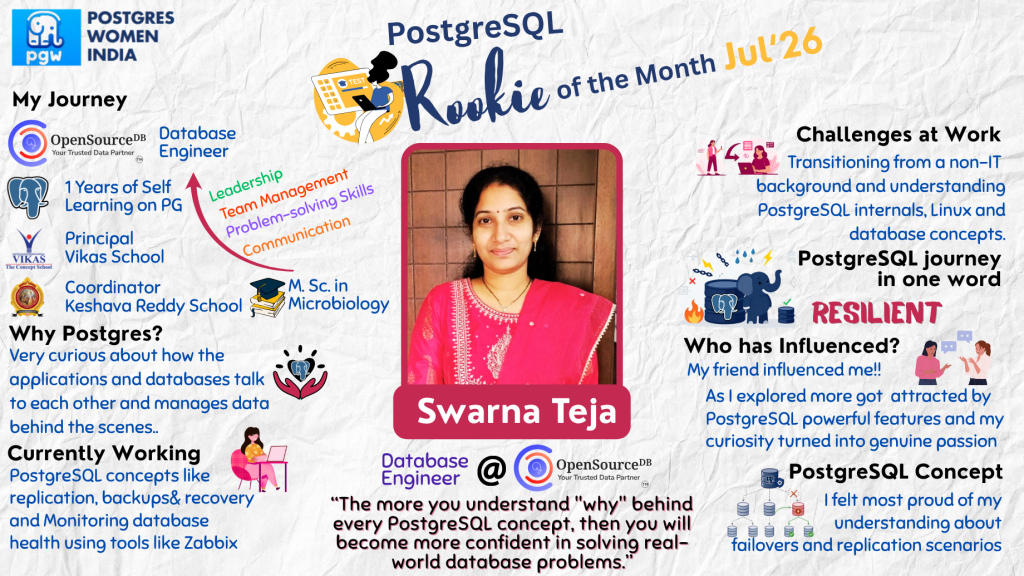
1) Let’s start with you!
Tell us a bit about yourself – your background, current role, and what excites you most in the world of tech.
I am Swarna Teja Uppalapati.I completed my M.Sc. in Microbiology.
Academic Experience:
I started my career in the education sector. I worked as a Coordinator at Keshava Reddy School and later as the Principal at Vikas School, where I worked for around 5 years. These roles helped me develop leadership, communication, team management, and problem-solving skills.
Transformation from Non-IT to IT:
After my career in educational sector, I developed a strong interest in technology and decided to transition into the IT field. I invested my time in learning PostgreSQL, Linux basics, database administration, backup and recovery, replication, high availability, and database monitoring tools through continuous learning and hands-on practice. This learning journey helped me successfully moved into IT, and I am now working as a Database Engineer at Opensource DB focusing on PostgreSQL administration and monitoring.
2) Why PostgreSQL? What inspired you to explore or switch to PostgreSQL?
I chose PostgreSQL because it is a Opensource database management system with strong community support and it is known for its reliability and robustness. Basically, I am very curious about how the applications and databases talk to each other and manages data behind the scenes.
3) What are you working on with PostgreSQL right now?
Share the cool stuff you’re building, learning, or solving using PostgreSQL.
Currently, I am working on some of the PostgreSQL related stuff on replication, backups& recovery and Monitoring database health using tools like Zabbix. At the same time, i am building my expertise in high availability and migrations ..These activities eventually helped me to solve the real-world challenges related to database performance, availability and seamless data migrations.
4) What’s been your biggest learning or challenge on this journey?
A lesson, mistake, or an aha moment, we’d love to hear about it!
Transitioning from a non-IT background and understanding PostgreSQL internals, Linux and database concepts felt little challenging in my initial days. But, through consistent practice and curiosity to learn new things from my peers makes things easy. The biggest mistake i have done in my initial days is focused more on memorizing the SQL commands. Later i realized understanding the logic behind it will helps a lot. The biggest “aha” moment came while i was working on schema migrations and fail over scenarios.
5) Your wisdom to rookies like yourself?
My wisdom is very simple: Stay curious and embrace the challenges in your learning journey. mistakes help you to dig the concepts in a deeper way. The pro tip, i wanted to share with you is the more you understand “why” behind every PostgreSQL concept, then you will become more confident in solving real-world database problems.
6) Finally, describe your PostgreSQL journey in one word.
Yep, just one!
Resilient
7) Who or what has influenced your PostgreSQL learning the most?
A mentor, a community, a course, a project, tell us what or who helped you grow.
One of my friends influenced me to start the PostgreSQL learning. As I explored more on it, I was attracted by its powerful features and realized that my curiosity turned into genuine passion. So, I wanted to build my career around this technology.
8) What’s one PostgreSQL concept or feature you finally understood and felt proud of?
That lightbulb moment when something clicked, we all have one!
The concepts I felt most proud of my understanding is failovers and replication scenarios. Initially they seemed to be complex, but after performing hands-on practice they became easier.


 Anuradha Chinta
 Haimantika Mitra
 Gayathri Varadarajan
  Chandini Kurada
  Vanya Seth
 Madhavi Datla

 Rumi
Rumi  Bhavani Indukuri