
Postgres Woman of the Year May 2026 - Shveta Malik
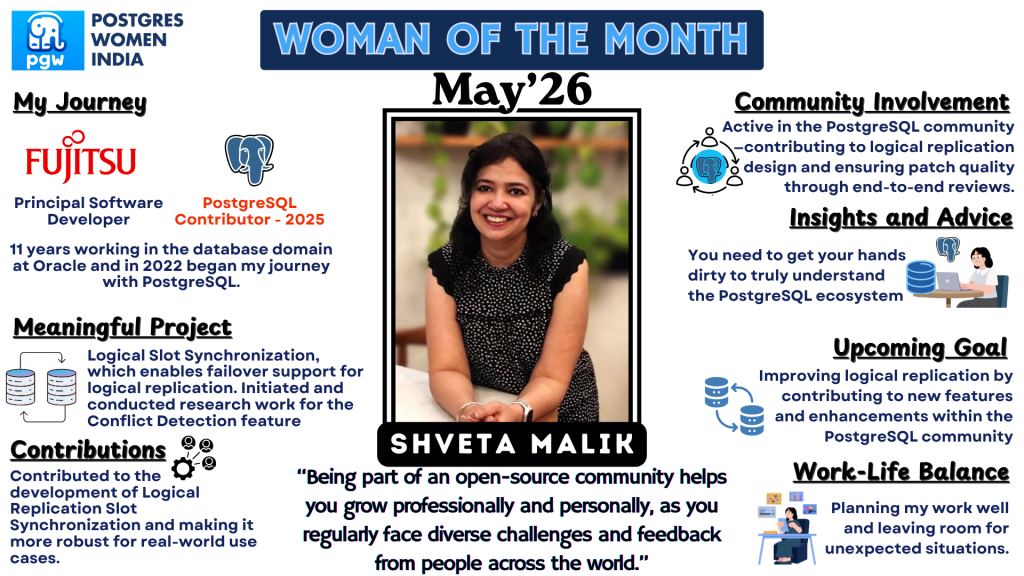
Introduction:
I graduated in 2007 with a degree in ECE from NIT Kurukshetra and then moved to Bangalore, where I am currently based. I began my career as a database developer at Huawei, then moved on to Apigee and later Oracle. I currently work with Fujitsu, contributing to the open-source PostgreSQL project.
I have spent most of my career working in the database domain, with expertise in query optimization, performance tuning, and logical replication. In the PostgreSQL community, my current role involves designing, authoring, and reviewing patches related to logical replication.
I was officially listed as a significant contributor in 2025.
Journey in PostgreSQL
I spent over 11 years working in the database domain at Oracle and was keen to explore PostgreSQL. I got that opportunity when I joined Fujitsu in 2022, which is when I began my journey with PostgreSQL.
Can you share a pivotal moment or project in your PostgreSQL career that has been particularly meaningful to you?
One of the most meaningful projects I worked on in PostgreSQL was Logical Slot Synchronization, which enables failover support for logical replication. Previously, if the publisher failed and a standby was promoted, logical replication slots were not available on the new primary, requiring manual intervention.
This work addressed that gap by synchronizing slots from the primary to standbys, allowing replication to continue seamlessly after failover.
I also authored patches for DDL Logical Replication, aiming to replicate schema changes along with data. Due to its complexity, it didn’t go through at that time, but it was a valuable learning experience.
Contributions and Achievements:
I’ve contributed to the development of Logical Replication Slot Synchronization, which enables failover support and improves the reliability of logical replication setups.
I also worked on the research and design of Logical Replication Conflict Detection, exploring ways to better detect and handle data conflicts in distributed environments. Both efforts focused on strengthening PostgreSQL’s replication capabilities and making it more robust for real-world use cases.
(II) Have you faced any challenges in your work with PostgreSQL, and how did you overcome them?
One of the main challenges I faced was adapting to PostgreSQL’s development infrastructure. Unlike typical corporate environments, most communication, patch submission, and reviews happen over email, which can make it harder to track discussions and follow the history of changes. This was quite a shift for me coming from my previous organizations. Over time, though, I’ve gotten more comfortable with the workflow and learned how to navigate it effectively.
Another challenge I faced was that getting a patch committed requires significant effort, as there are often multiple opinions and alternative approaches from the community. Convincing others and building consensus can be quite challenging. However, this is part of working in an open-source environment, and over time, you learn how to navigate it effectively.
Community Involvement:
I engage with the PostgreSQL community on a daily basis by contributing design inputs to ongoing features in logical replication. I also actively review and validate patches end-to-end to ensure they meet high quality standards before being committed.
(II) Can you share your experience with mentoring or supporting other women in the PostgreSQL ecosystem?
I haven’t had formal experience specifically mentoring women, but I’m always open to helping and guiding anyone who reaches out to me. I’ve also supported a colleague in transitioning to PostgreSQL and helped her navigate the initial stages of her journey in the ecosystem.
Insights and Advice:
Go for it. Don’t hesitate to dive in; you need to get your hands dirty to truly understand the PostgreSQL ecosystem. There are no shortcuts, but the learning is absolutely worth it.
(II) Are there any resources (books, courses, forums) you’d recommend to someone looking to deepen their PostgreSQL knowledge?
The PostgreSQL official documentation is a great place to start. It’s comprehensive and covers everything from basics to advanced topics.
For building a strong foundation, I also recommend the guide available at https://www.interdb.jp/pg/ , which explains PostgreSQL internals in a very clear and structured way.
Looking Forward:
I’m looking forward to DDL Logical Replication and Conflict Resolution, as they will further strengthen PostgreSQL’s logical replication capabilities.
(II) Do you have any upcoming projects or goals within the PostgreSQL community that you can share?
My goal is to continue improving logical replication by contributing to new features and enhancements within the PostgreSQL community. I also look forward to gaining exposure to the optimizer layer.
Personal Reflection:
It means collaborating with a diverse group of experts, both within and outside my organization, while continuously learning and growing.
(II) How do you balance your professional and personal life, especially in a field that is constantly evolving?
It comes naturally to me, and I don’t have to consciously work too hard on it. It mainly comes down to planning my work well and leaving room for unexpected situations.
Message to the Community:
It’s a great place to work that offers a lot of exposure and learning opportunities. Being part of an open-source community helps you grow professionally and personally, as you regularly face diverse challenges and feedback from people across the world.


 Anuradha Chinta
 Haimantika Mitra
 Gayathri Varadarajan
  Chandini Kurada
  Vanya Seth
 Madhavi Datla

 Rumi
Rumi  Bhavani Indukuri