
EnableHER – Honoring the Backbone Builders
At Postgres Women India, we believe strong tech communities are built not only by engineers and database experts, but also by the incredible women who enable ecosystems to grow every day.
Introducing EnableHER — an initiative to celebrate women driving impact across the Data, AI, and Open-source ecosystem through community building, platform growth, operations, outreach, partnerships, design, events, and engagement.
EnableHER will spotlight inspiring women who create opportunities, foster collaboration, and strengthen communities in meaningful ways.
Her Journey with Community & PostgreSQL
1. Tell us a little about yourself and your journey so far.
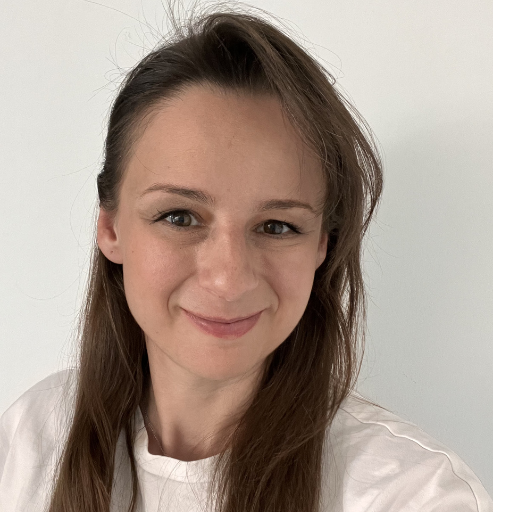
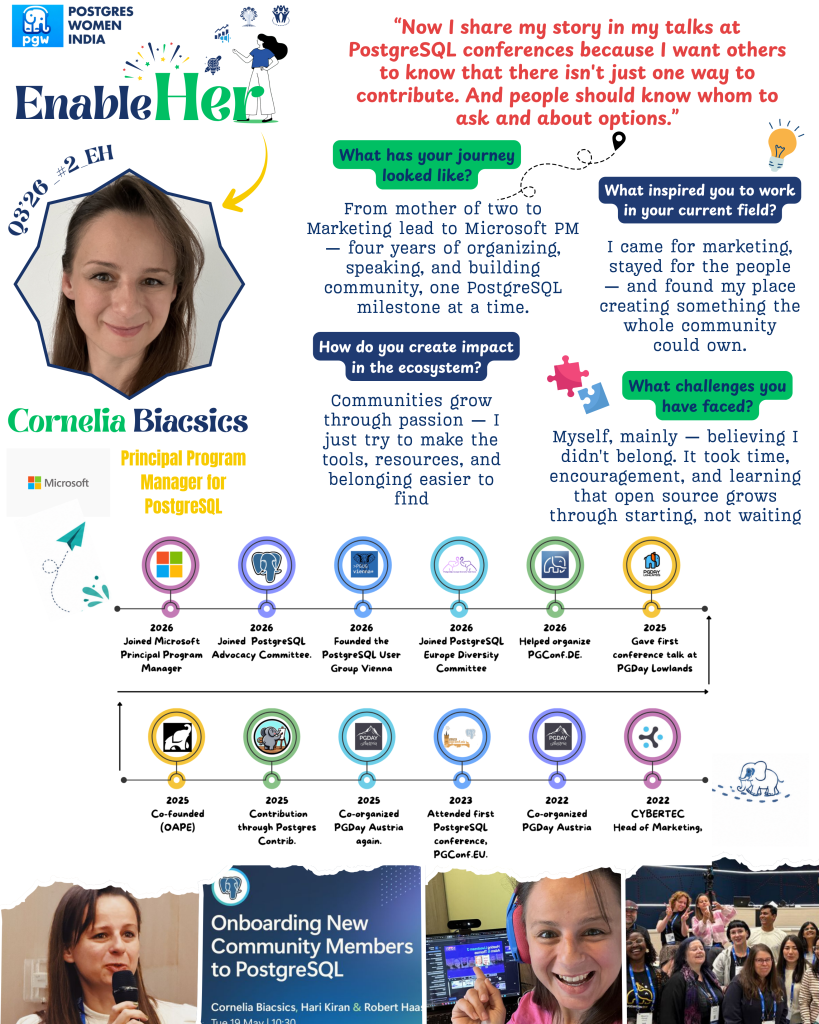
I am 37 years old, a mom of two children and a very creative person who draws energy from new ideas and constantly looks for ways to improve things.
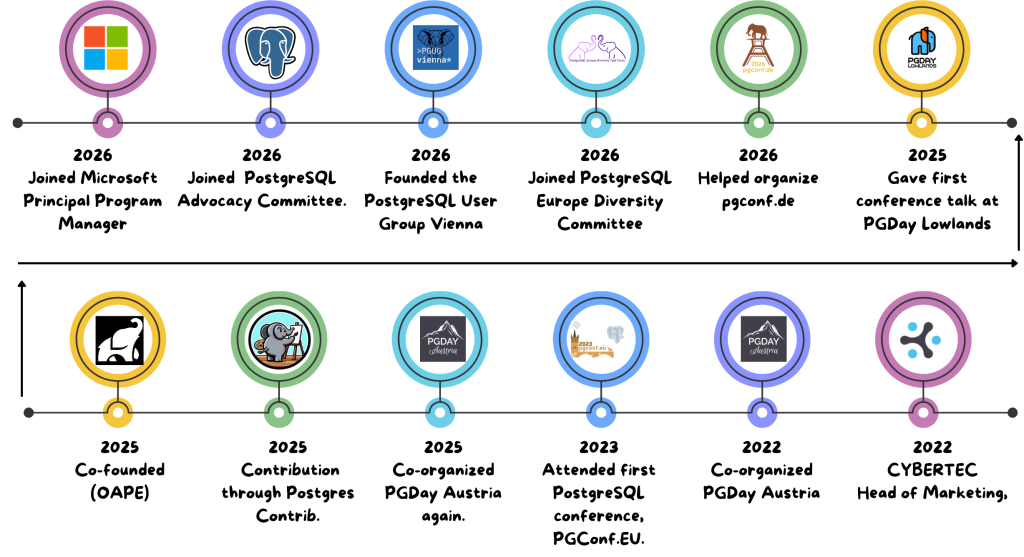
2022: I joined CYBERTEC as Head of Marketing in February, marking the beginning of my journey in the PostgreSQL ecosystem.
2022: Co-organized PGDay Austria for the first time.
2023: I attended my first PostgreSQL conference (PGConf.EU 2023)
2025: Co-organized PGDay Austria again.
2025: Started actively contributing to the PostgreSQL community when I joined the team behind Postgres Contrib, highlighting non-code contributions on a weekly basis (postgres-contrib.org).
2025: Co-founded the Open Alliance for PostgreSQL Education (OAPE).
2025: Gave my first conference talk at PGDay Lowlands 2025 and later spoke at PGConf.EU 2025.
2026: Helped organize PGConf.DE 2026.
February 2026: Joined the PostgreSQL Europe Diversity Committee.
March 2026: Founded the PostgreSQL User Group Vienna.
March 2026: Joined the PostgreSQL Advocacy Committee.
March 2026: Joined Microsoft as a Principal Program Manager for PostgreSQL, where I can continue making a positive impact on the PostgreSQL project and its community.
Today: I am passionate about enabling people to contribute, growing communities, and making the PostgreSQL ecosystem more accessible and welcoming for everyone.
2. What inspired you to work in your current field, community, or ecosystem?
When I attended my first PostgreSQL conference in 2023, I immediately felt the vibrant energy of the community. At the time, I had no idea that someone with a background in marketing could become an active member of such a highly technical community.
Over time, through my work at a PostgreSQL vendor, I began to discover more and more of the small pieces that make the ecosystem work, including the people who truly make the community a community. At first, my curiosity was driven by the desire to better support my employer. But as I got to know the projects and, more importantly, the people behind them, I became attached to the project itself. I wanted to help, not because it was part of my job, but because I genuinely started to care.
To my surprise, I found areas where I could contribute from a marketing/ communication perspective. Realizing that my skills could be valuable to the community was both humbling and incredibly rewarding.
One of my first ideas came while looking at the author profiles of PostgreSQL contributors on a commercial website. I wanted to make it immediately visible that these individuals were named PostgreSQL contributors, that visual recognition matters for PostgreSQL companies. Creating a vendor-specific badge didn’t feel right; the recognition should directly come from the community, not from a company. So I wondered: what if we created a contributor badge for the PostgreSQL community itself? One that individuals could use to visually show that they are contributors.
With guidance from members of the community, I reached out to different groups to gather feedback and hear their perspectives. The conversations were incredibly encouraging. What started as a small idea quickly opened doors to many other community initiatives, and before I knew it, I had become involved in projects across the PostgreSQL ecosystem.
Bruce Momjian said in an interview with Claire Giordano (Open Source Leadership with Bruce Momjian) “.. if you’re working for a company, you have to work on the code. You don’t have a choice, right? But with open source, you really do have a choice because they’re all volunteers.” and I believe that summarizes it quite well. You can pick your topics that you’re passionate about. This is a thing you can’t always do it in your bread-job.
3. In your own way, how do you think your work enables people, teams, or communities to grow?
I would rather say that I try to enable. Communities grow through people’s genuine passion. Everything else comes automatically with passion. What I try to do is make sure the right tools and assets are in place to help the community grow.
One example is supporting local meetups, which are incredibly important for spreading the word about PostgreSQL and the Community. Because they have so much potential, I recently put together a (very basic) slide deck for meetup organizers. It introduces different parts of the PostgreSQL ecosystem and collects resources that already exist. The community has created so many great projects and initiatives over the years, but they can sometimes be difficult to discover. The deck doesn’t introduce anything new—it simply brings together ecosystem projects (both from PostgreSQL itself and from community members) and links to useful resources in one place. I hope it makes those first steps a little easier.
I remember my own early days with PostgreSQL. I never imagined that I could play a role in this community. Today, I share that story in my talks at PostgreSQL conferences because I want others to know that there isn’t just one way to contribute. And people should know whom to ask and about options.
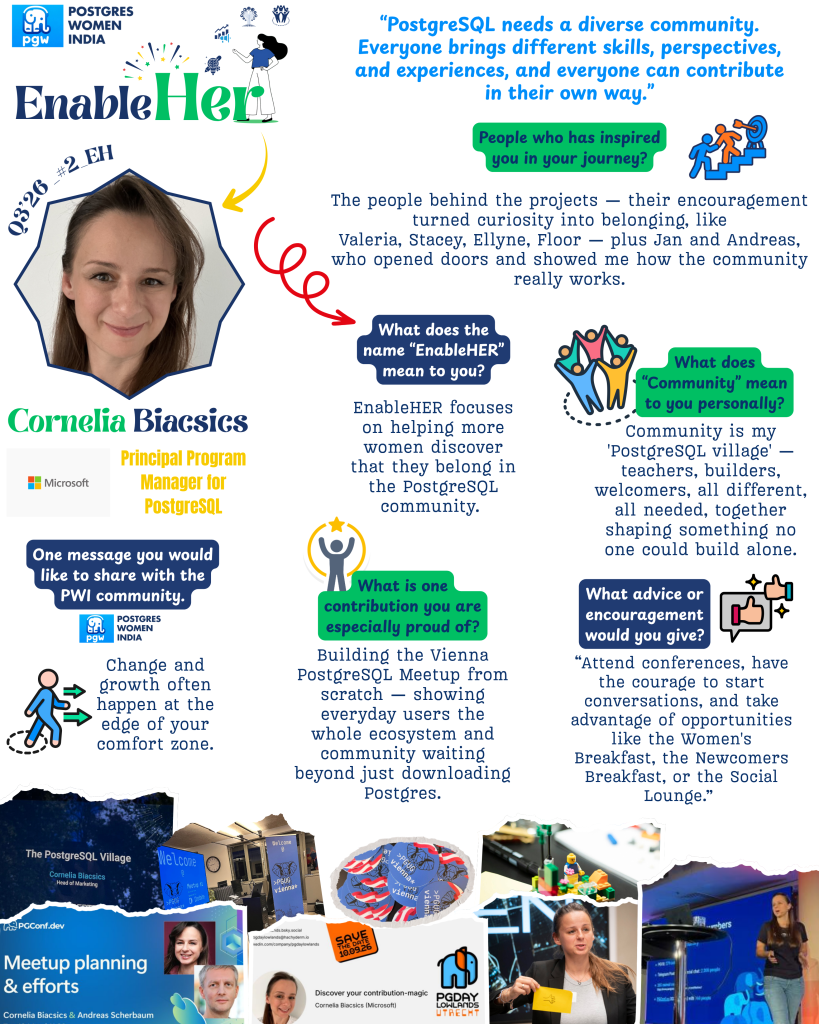
PostgreSQL needs a diverse community. Everyone brings different skills, perspectives, and experiences, and everyone can contribute in their own way. That’s also why I’m part of the Diversity Committee, which helps underrepresented groups—including newcomers—find their place and feel welcome in the community. Creating an inclusive environment is essential, because communities can only grow when people feel that they belong.
4. What is one contribution, initiative, or achievement you are especially proud of, and why?
So far, starting a PostgreSQL Meetup group in Vienna feels like my biggest contribution to the community.
Before organizing the first meetup, I assumed that most PostgreSQL users had a similar understanding of the PostgreSQL community as I did. But during that first event, when I presented the upcoming conferences and talked about different parts of the ecosystem, I realized that many people use PostgreSQL every day without knowing much about how the community operates or what exists beyond downloading PostgreSQL itself.
There are millions of PostgreSQL users, but many of them don’t know how to engage with the ecosystem, use its community infrastructure, or find ways to contribute – or just the “why”. For an open source project like PostgreSQL, which depends on its community, that’s incredibly important. Somehow, I had assumed people already knew these things. But helping people at the edge of the ecosystem discover and engage with the community is a vital part of keeping the ecosystem healthy and growing.
I built the meetup group completely from scratch: finding the first sponsor, recruiting the first speakers, attracting the first attendees, and setting up all the supporting infrastructure. That included creating the meetup.com group, establishing the branding, launching a LinkedIn page, preparing presentations and agendas, and regularly sharing updates to keep people engaged.
In my opinion, alongside conferences, local meetups are one of the most effective ways to support the PostgreSQL community. They lower the barrier to entry, connect people with one another, and help newcomers discover that there is an entire ecosystem behind the database they already use.
5. What challenges or barriers have you faced in your journey, and how did you navigate through them?
Myself, mainly.
The biggest obstacle was my own belief that I didn’t (or couldn’t) belong in such a highly technical community. I was wrong. It took time, as well as encouragement and support from other people (especially those contributing in non-technical ways), for me to truly believe that contributions from non-technical community members are needed and valued, too.
It also took time to observe and understand how the community works as a whole. Only then was I able to recognize the many different moving parts and identify where my own skills could make a difference.
Coming from the commercial world, I initially struggled with the lack of formal authorities or approval processes. I was used to someone being responsible for making decisions and giving the green light. It took me a while to realize that, in an open source community, the best thing you can often do is simply start something, involve others, ask for feedback, and let the idea evolve together with the community.
6. What does “community” mean to you personally?
I have this idea of the “PostgreSQL village.”
To me, the PostgreSQL community is like a village. A village isn’t built by one kind of person. It has teachers, maintainers, builders, entertainers, craftspeople, and many others – even from different origins and backgrounds. It is the diversity of its people that allows it to grow and thrive.
I see PostgreSQL in much the same way. There are people who shape the future of the village, people who maintain it, people who welcome newcomers and visitors, people who build infrastructure, people who educate others, and people who create spaces where the community comes together. Every role matters, even if it isn’t immediately visible.
What makes the PostgreSQL community special is that it brings together people with different backgrounds, skills, and interests, all working toward a shared goal: making PostgreSQL better. No single person could build the village alone, but together, everyone helps it grow. Every contribution, whether technical or non-technical, is another piece of the village.
7. What does the name “EnableHER” mean to you?
Creating an environment where people feel comfortable becoming part of the community is one of its most important responsibilities. Trust, encouragement, and enablement are essential for helping a community grow. To me, enablement is a key part of building healthy communities.
EnableHER focuses on helping more women discover that they belong in the PostgreSQL community.
That brings me back to my idea of the PostgreSQL village. A village thrives because it is built by people with different backgrounds, perspectives, and skills. It needs teachers, maintainers, builders, craftspeople, organizers, communicators, and many others. The same is true for PostgreSQL.
If part of the population doesn’t feel welcome or doesn’t see a place for themselves in the village, the community misses out on potential contributors—not because they are women, but because they are people with valuable experiences, ideas, and skills who never become part of the community.
By helping more women participate, contribute, and discover that they belong, EnableHER helps ensure that PostgreSQL benefits from the broadest possible range of contributors. In the end, enabling people to find their place in the village makes the village stronger.
8. What advice or encouragement would you give to women looking to grow in technology, open-source, leadership, or communities?
I like to use my own journey as an example for people who think they can’t contribute to the PostgreSQL community. The truth is that everyone (really everyone) has something they can contribute. Every human is unique and we all have a special set of skills.
For me, attending a PostgreSQL conference and getting to know people was the turning point. My advice is simple: attend conferences, have the courage to start conversations, and take advantage of opportunities like the Women’s Breakfast, the Newcomers Breakfast, or the Social Lounge. These spaces make it much easier to meet people, ask questions, and discover where you can find your own place in the community.
9. Is there a woman, mentor, colleague, or community contributor who has inspired you in your journey?
Absolutely!
I’m incredibly grateful to have met people like Valeria Kaplan, Stacey Haysler, Ellyne Pneah, and Floor Drees. They all had a meaningful impact on my journey and helped me realize that I belong in this community.
There were also many men who supported me along the way. Jan Karremans introduced me to other people in the PostgreSQL community and helped me build my first connections. Andreas Scherbaum introduced me to the community’s workflows and showed me how things work behind the scenes. Their guidance and encouragement made it much easier for me to find my place and start contributing.
10. One message you would like to share with the PWI community.
Change and growth often happen at the edge of your comfort zone.
EnableHERs Who Inspire


 Anuradha Chinta
 Haimantika Mitra
 Gayathri Varadarajan
  Chandini Kurada
  Vanya Seth
 Madhavi Datla

 Rumi
Rumi  Bhavani Indukuri