
Postgres Woman of the Month | June 2026 - Valeria Kaplan
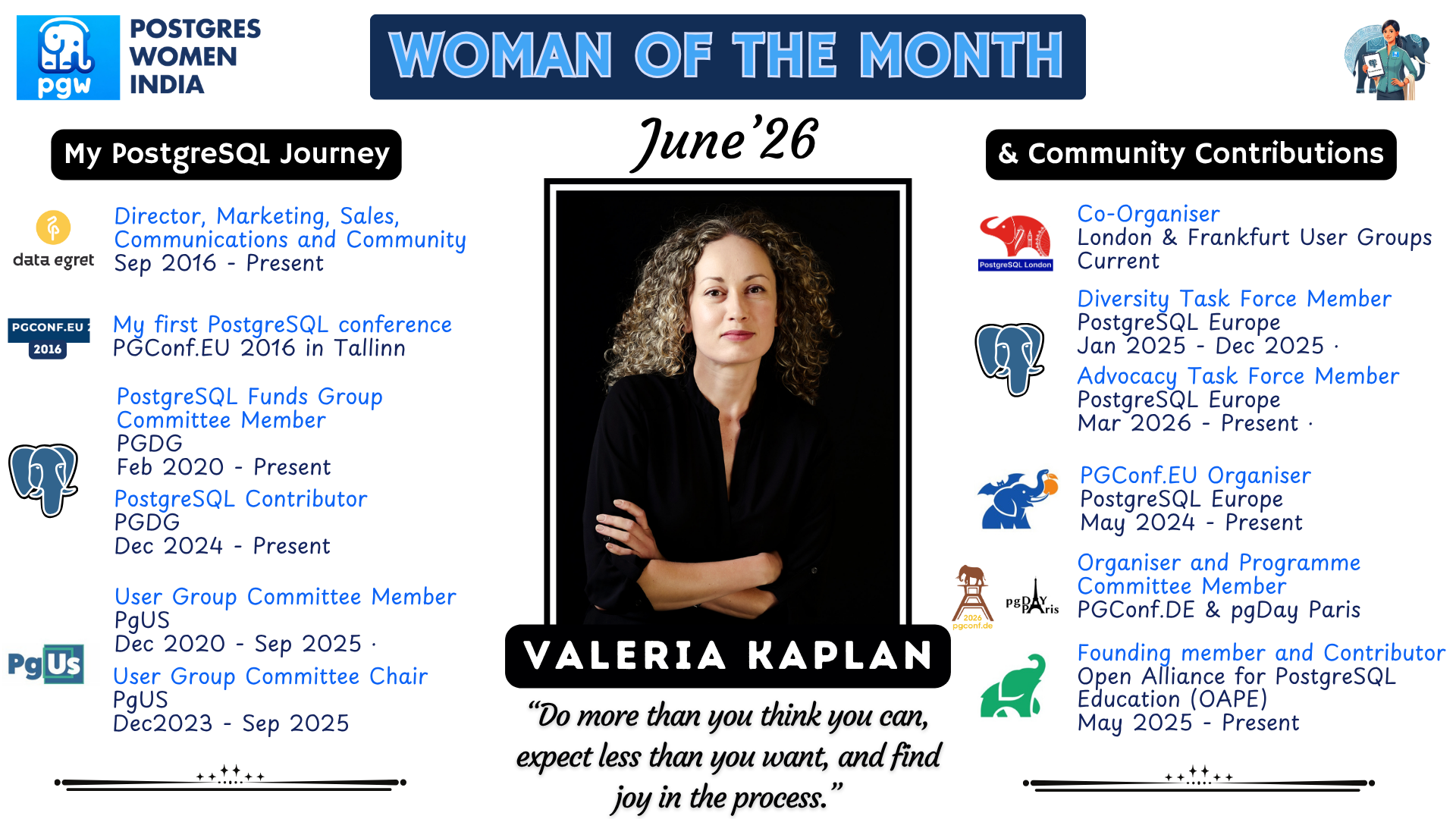

Introduction:
My PostgreSQL journey started around 2016, when I joined Data Egret, a PostgreSQL consultancy, and quickly found myself drawn not just to the technology but to the people behind it. Over six years of active community involvement, that pull has only grown stronger — and I’m proud to have been recognised by the community as a Significant Contributor.
Along the way I’ve taken on roles that let me give back in different ways: serving on the PgUS User Group Committee (including two years as Chair), and being part of the task force that launched the PostgreSQL Europe Diversity Committee — a project that felt particularly meaningful to me.
These days I’m a member of the Postgres Funds Group and have been co-organising PGConf.EU since 2024. I’ve also been involved in pgDay Paris and PGConf.DE as both an organiser and programme committee member. Most recently I joined the co-founding team behind the Open Alliance for Postgres Education and the PostgreSQL Europe Advocacy Task Force — because after 30 years, Postgres still has so much room to grow, and I want to be part of bringing it to communities that haven’t fully embraced it yet.
Journey in PostgreSQL`
I joined Data Egret almost ten years ago, and that was my entry point into both PostgreSQL and the IT industry. But it wasn’t my first experience of a close-knit technical community. Before that I spent close to 15 years working with researchers and medics, and I was struck by how much the two worlds have in common: that same curiosity, and that same openness to discussing everything and anything.
What really sealed it for me was attending my first PostgreSQL conference, PGConf.EU 2016 in Tallinn. I was completely captivated by the energy of the community, and I think that’s the moment I knew I wanted to be part of it in a more active way.
Can you share a pivotal moment or project in your PostgreSQL career that has been particularly meaningful to you?
It’s hard to point to a single pivotal moment. To me, the PostgreSQL community feels like an endless patchwork, with each person I work closely with adding a new and colourful patch to it. That’s what makes the journey so rich.
That said, one of the highlights to date was attending PGConf.dev just a few weeks ago. It’s a different kind of conference from the user-focused events I’d attended before; it’s really about the community itself and how it grows and develops. I met people I’d worked with remotely but never seen in person, reconnected with people I hadn’t seen in a while, and found myself surrounded by content and conversations that made me want to do more. There’s something about being in a room full of people who care so deeply, not just about the technology but about each other and about PostgreSQL’s future, that feels absolutely captivating. I left full of drive, energy and excitement, with a sense of belonging that is hard to put into words. learning experience.
Contributions and Achievements:
You can find full list of my community contributions at https://www.linkedin.com/in/valeriakaplan/details/volunteering-experiences/
(II) Have you faced any challenges in your work with PostgreSQL, and how did you overcome them?
In the beginning I found it a bit challenging to navigate the community and understand the roles of the different committees and entities that make up the PostgreSQL ecosystem. But as I talked to more people and met new ones, I gradually found my way through it.
What really helped me consolidate that knowledge was preparing a talk on the topic. I had built up a picture of how the community operates through conversations and interactions, but when I had to put it into slides I was forced to properly structure what I had learned. That process of turning experience into something teachable is what truly sealed my understanding. The talk, “Elephant in a Nutshell: Navigating the Postgres Community 101,” was first presented at PGConf.EU 2023 and I gave it again at pgDay Paris 2024, which felt like a sign that it resonated with others who were finding their own way into the community.
Community Involvement:
I engage with the PostgreSQL community on a daily basis by contributing design inputs to ongoing features in logical replication. I also actively review and validate patches end-to-end to ensure they meet high quality standards before being committed.
(II) Can you share your experience with mentoring or supporting other women in the PostgreSQL ecosystem?
The PostgreSQL community has done a lot in recent years to diversify, and that work matters. At the same time, the number of women is still relatively small, so we hold on to each other. Over the years I’ve been approached by different women in the community for help and advice, and while I wouldn’t necessarily call it mentorship, I think of it more as being a good citizen: reassuring and empowering the people around you.
In practice that looks like many different things. Sometimes it’s walking someone through the steps of organising a local user group, or encouraging someone to put themselves forward for a programme committee. Sometimes it’s simply making an introduction or connecting two people who should know each other. None of it is formal, but I think that’s the point. The most meaningful support often happens in the margins of a conference or in a quiet conversation, not only through a structured mentorship programme.
Insights and Advice:
My advice to women entering technology and PostgreSQL is the same as I would give to anyone wanting to get active in the community: do more than you think you can, expect less than you want, and find joy in the process.
(II) Are there any resources (books, courses, forums) you’d recommend to someone looking to deepen their PostgreSQL knowledge?
There are many great resources depending on your goals and skill level. The official PostgreSQL documentation is an excellent starting point and genuinely one of the best-written resources in the open source world, and it is worth spending time with even if you consider yourself a beginner.
For books, the PostgreSQL community maintains a library of titles written by authors from within the community, covering a wide range of topics and skill levels. You can find the full list at postgresql.org/docs/books.
If your goal is to get closer to PostgreSQL development itself, I’d recommend subscribing to the pgsql-hackers mailing list. It gives you a real window into how the project develops, how the Commitfest process works, and how patches move through the community. For those who want to go further and contribute code, Robert Haas runs a mentorship programme specifically for code contributors, which is a wonderful resource for anyone taking their first steps in that direction. You can find out more at rhaas.blogspot.com/2024/06/mentoring-program-for-code-contributors.html.
And of course, the PostgreSQL community itself is a resource. People are generally open, welcoming and happy to answer questions, whether that’s at a conference, in the community Slack, or on the mailing lists.
Looking Forward:
Technologically, AI is one of the biggest challenges and opportunities, while expanding beyond the usual PostgreSQL audience and bringing in fresh contributors is the organizational challenge I think about most. I foresee a lot of good work being put forward by the many dedicated and smart people who are currently standing at the steering wheel of the community. We got this far in 30 years, and I believe we can go much further in the next 30.
(II) Do you have any upcoming projects or goals within the PostgreSQL community that you can share?
The two big things on my horizon for the coming year are the launch of the first PostgreSQL certification through the Open Alliance for Postgres Education, and working with the PostgreSQL Europe Advocacy Task Force on building connections with developer communities that haven’t fully embraced PostgreSQL yet. Both feel like meaningful steps forward and I’m excited to be part of them.
Personal Reflection:
It means belonging to something bigger than yourself, built by people who genuinely care: about the technology, about each other, and about what comes next.
(II) How do you balance your professional and personal life, especially in a field that is constantly evolving?
Sometimes life lifts you up when community work feels overwhelming, and sometimes the community is what lifts you up when you face personal challenges. That, to me, is the real balance.
Knowing that there are people who are there for you in happiness and in sadness, and knowing that you are the person they will seek out to share their ups and downs.


 Anuradha Chinta
 Haimantika Mitra
 Gayathri Varadarajan
  Chandini Kurada
  Vanya Seth
 Madhavi Datla

 Rumi
Rumi  Bhavani Indukuri